It didn't flow? Inconceivable!
Research team's findings in Nature present unprecedented markers of a potential supersolid phase in graphene
To non-physics folks, the behavior of quantum materials such as superfluids is strange, to say the least. Compare it to an ordinary liquid, like your beverage of choice. If you stir said beverage, the predictable response is that the liquid will swirl so long as you keep stirring; once you stop, the liquid will eventually slow to standstill. But if you stirred a superfluid, in which the atoms are so perfectly aligned that they experience zero friction, it will remain in motion indefinitely, whether you continue stirring or not. It may even seep right through its container (seriously).
As strange as this behavior may seem, there's nothing unpredictable about it to physicists, who have known about superfluidity since it was first observed in 1938. But a team of researchers led by CU Physics Professor Cory Dean and Associate Professor Jia Li at the University of Texas at Austin have recently revealed behavior in superfluids that is decidedly unpredictable: the spontaneous transition of atoms from constant frictionless movement to sudden fixed immobility. In other words, a potential demonstration of "supersolidity." While physicists have long theorized that just as superfluids are the quantum version of classical fluids, there could be a quantum equivalent of classical solids, the phase had never been observed. But with the publishing of the team's findings in Nature this past January, the word "never" may no longer apply.
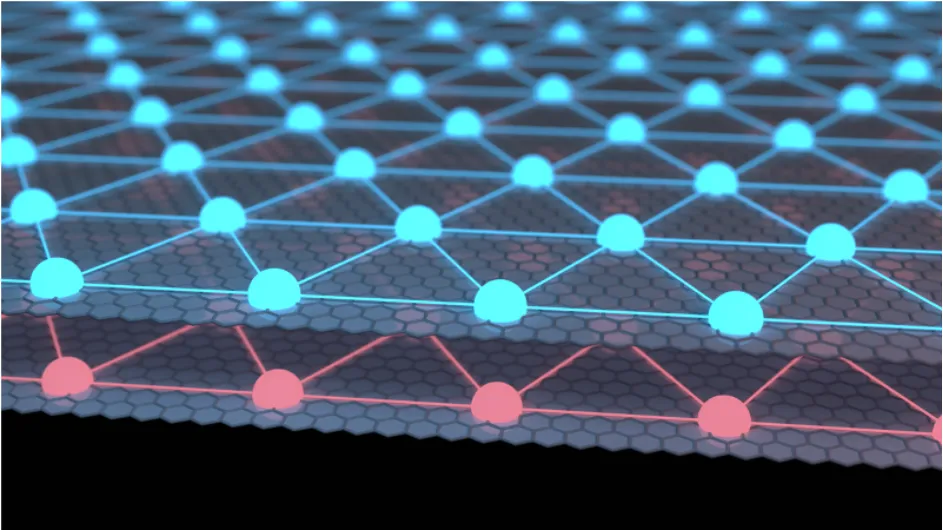
In carrying out their experiment, Dean and Li's team used their expertise in novel 2D material to explore superfluidity in graphene, a crystalline solid comprised of a single layer of carbon atoms. When layered and methodically exposed to magnetic fields, graphene can produce excitons, and at extremely low temperatures, excitons can form superfluids. An added advantage of working with graphene is that scientists can adjust the density of graphene layers. The team knew that in a high density-low temperature state, graphene behaves like a superfluid. But what happened if they decreased the density? The excitons stopped moving to initiate an unexpected insulating phase. And if they then increased the temperature? The excitons behaved like a superfluid again.
Beyond having possibly demonstrated a quantum state that heretofore had only been theorized, the prospective applications of these findings are enormous. Naturally-occurring superfluids, like helium, are much heaver than 2D materials, with superfluidity only achieved and controlled through temperature. Two-dimensional materials are not only lighter, they also have more properties that can be manipulated (e.g., magnetism, temperature, and density), significantly increasing the flexibility and control that scientists can exert.
In addition to Dean and Li, himself a former postdoctoral fellow in Dean's Lab, co-authors of the paper include the following current and former members of Dean's Lab: PhD students Yihang Zeng (now an associate professor at Purdue), Dihao Sun, postdoctoral researcher Qianhui Shi (now an associate professor at UCLA), and undergraduate student Anna Okounkova (now pursuing her PhD at the University of Washington).
Read the team's full paper in Nature at "Observation of a superfluid-to-insulator transition of bilayer excitons."