Columbia researchers advocate Congress to expand quantum funding
Physics faculty member Sebastian Will joined fellow panelists from Columbia and Stony Brook to enlighten Congress about the importance and future of quantum science
In 2018, Congress passed the National Quantum Initiative Act to support and accelerate the development of quantum science and quantum-related technology. Eight years on, STEM funding is deeply in flux. This January, amid sweeping federal cuts to higher education, Senator Todd Young (R-IN), along with Senator Maria Cantwell (D-WA), sponsored the bipartisan National Quantum Initiative Reauthorization Act to "expand the number of researchers, educators, and students with training in quantum information science, engineering, and technology to develop a domestic workforce pipeline and retain international talent to the extent consistent with national security and international competitiveness." The importance of quantum science research and development is not lost on Senator Young. "Quantum technologies promise to dramatically transform every industry and sector of our economy," he said, "and revolutionize our technological capabilities."
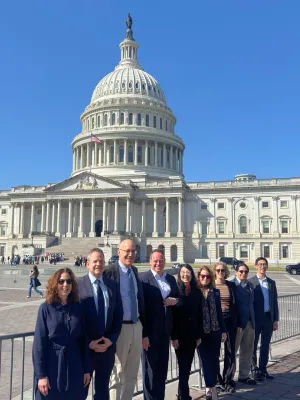
While the Reauthorization Act already has more endorsement from members of Congress than the original legislation had in 2018, approval isn't guaranteed. In an effort to sway her colleagues, Senator Kirsten Gillibrand (D-NY) invited a group of researchers to join a panel discussion on the value and merits of investing in quantum science. Among the panelists was CU Physics professor Sebastian Will, joining colleagues from Columbia and Stony Brook University in presenting their case on Capitol Hill and fielding questions.
As noted in Columbia News, the panelists sought to provide important context on the current state of quantum research. Columbia has been a leading institute in quantum research, having been awarded $10.7 million in funding from the U.S. Department of Energy (DOE) in 2018 to establish a new Energy Frontier Research Center (EFRC) as well as co-establishing the Max Planck – New York Center for Non-Equilibrium Quantum Phenomena with the Flatiron Institute and Max Planck Society. Moreover, it has one of the four labs connected through the longest quantum network in North America, which stretches 170 miles to link Columbia, Stony Brook, Brookhaven National Laboratory, and Yale.
Professor Will highlighted the transformative potential of such technology, which takes advantage of the quantum phenomenon known as entanglement. Current technology uses light to encode information and then teleports the photons along these quantum networks. The networks also include a crucial element of data security: they cannot be intercepted. In explaining the current landscape, Professor Will noted that these technologies are now ready to scale and are waiting for advancements in interfaces that will allow the photons to interact with qubits, the unit of information that quantum computers use to encode information.
The United States is positioned to be a global leader in this technology, but members of the panel emphasized this cannot happen unless there continues to be significant federal funding for research in quantum technology and quantum information. While the 2018 act runs through 2028, the Reauthorization would provide important updates and added resources, including the establishment of up to three new National Institute of Science and Technology (NIST) quantum centers, the creation of five new National Science Foundation (NSF) Multidisciplinary Centers for Quantum Research and Education, a quantum education and workforce hub, and new quantum testbeds.
On March 4, the Senate Committee on Commerce, Science, and Transportation passed a bill to strengthen support for research conducted by the NOAA Weather Program Office. Advocates of the NQI Reauthorization Act hope this is a bellwether decision that demonstrates a willingness to approve other STEM-related funding. Beyond the enthusiasm of individual researchers like those on Senator Gillibrand's guest panel, the Reauthorization Act has received public endorsements from the American Physical Society, the Association of American Universities, and the Quantum Industry Coalition.