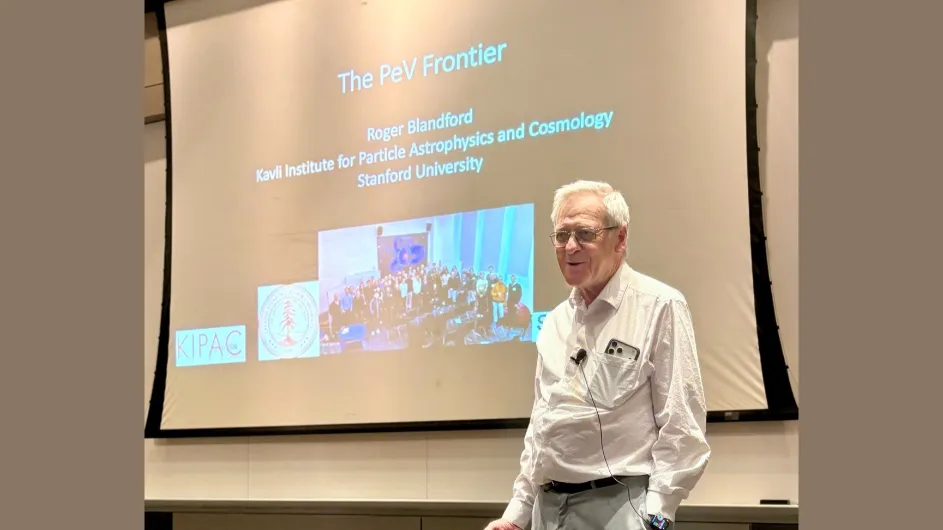
On Monday, November 16, Columbia Physics welcomed Dr. Roger Blandford, Luke Blossom Professor in the School of Humanities and Sciences, and Professor of Physics and Particle Physics and Astrophysics at Stanford University, to the Theory Center in Pupin Hall for the 3rd Annual Schwinger Lecture.
Established in 2024 with the support of the Julian Schwinger Foundation, the event celebrates the legacy of Columbia alumnus and 1965 Nobel Laureate Julian Schwinger. Schwinger, who received his BA in 1936 and his PhD in 1939 from Columbia, was instrumental in establishing quantum electrodynamics and laid the foundation for advances across fields including particle physics, condensed matter physics, nuclear physics, and electrical engineering.
Blandford expanded the annual lecture series to astrophysics with his talk on the PeV Frontier, high-energy signals from space with mysterious origins. He flew kites, in his own words, of possible explanations, ranging from known entities such as black holes, neutron stars, and shock fronts to exotic explanations for which there is no other evidence. He also stressed the importance of being open-minded as a scientist to the audience—paraphrasing Dwight Eisenhower, 34th President of the United States and 13th President of Columbia: "Planning is everything, but plans are worthless."
Blandford’s lecture followed those of Frank Wilczek, Herman Feshbach Professor of Physics, Emeritus, at the Massachusetts Institute of Technology and 2004 Nobel Laureate, who discussed the symmetries of time for the inaugural Schwinger Lecture in 2024, and Duncan Haldane, Sherman Fairchild University Professor of Physics at Princeton University and 2016 Nobel Laureate, who explained quantum geometry and the quantum Hall effect in 2025. Blandford returned to the Theory Center on Tuesday for lunch with Physics Department students.
“The Julian Schwinger Lectures draw a wide audience of students and faculty,” says Dmitri Basov, Higgins Professor of Physics at Columbia and curator of the series. “Schwinger’s own interests in physics were truly panoramic, and so is the scope of topics covered by the Schwinger lecturers. These are some of the most original thinkers in contemporary physics.”
In addition to bringing distinguished scientists to Columbia each year for the annual lecture, the Schwinger Foundation’s gift to Columbia Physics supports exceptional PhD students in the department through the Julian Schwinger Fellowship. The inaugural fellow, Ilia Komissarov, studied quantum geometry and strongly correlated states of matter with theoretical physicist Raquel Queiroz; he graduated in 2025 and is now a postdoctoral fellow at Louisiana State University. The current Julian Schwinger Fellow, Anirudh Patel, is a member of the Theoretical High Energy Astrophysics group studying the microphysics underlying extreme phenomena and how they manifest in observable properties with astrophysicist Brian Metzger.
The next Schwinger Lecture is expected to take place in Fall 2027.